
Keywords
Retinal Vein Occlusion
Hyperopia
How to Cite
Abstract
Introduction: Retinal vein occlusion is characterized by retinal and subretinal haemorrhages, macular oedema, and a varying degree of retinal ischemia. There is an increased risk with cardiovascular diseases but not all people with retinal vein occlusion reflect aggressive form of systemic diseases. In that situation, the role of ocular biometry and refraction is still essential to be studied.
Objectives: To compare the ocular biometry and refractive error of affected eyes of patients with retinal vein occlusion to their fellow eyes and the control group.
Methodology: This is a cross-sectional comparative study carried out at B.P. Koirala Lions Centre for Ophthalmic Studies. Ethical clearance was obtained from the institutional review committee of institute of Medicine. The calculated sample size was 60. After obtaining informed consent, 67 patients with retinal vein occlusion and 67 controls were enrolled using purposive sampling technique. Refractive error was determined using an auto-refractometer (Topcon KR-800). Keratometry, Anterior chamber depth, and Axial length were measured using IOL-Master-500. Different statistical test like t-test, chi-square test and ANOVA were used to analyse the data.
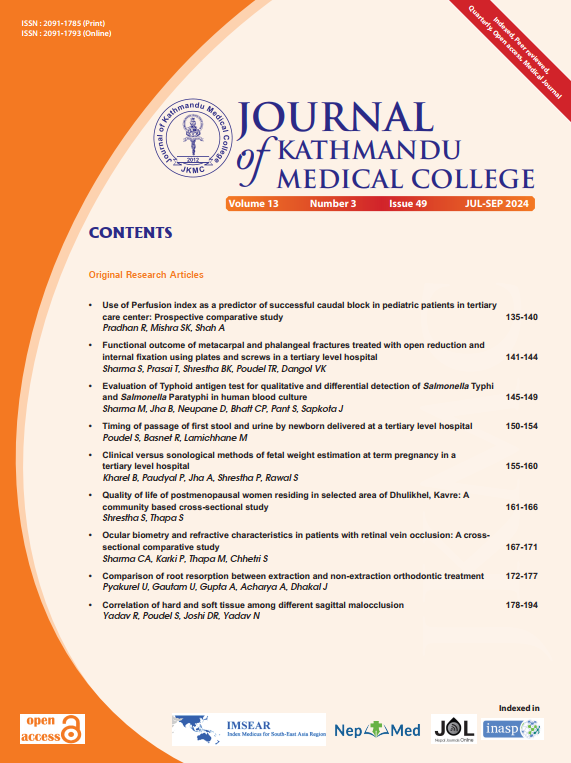
Results: The eyes with retinal vein occlusion were not significantly different either from fellow eyes or the control group in biometric indices like average keratometry, anterior chamber depth, and axial length. Significant hyperopia was found among central retinal vein occlusion group as compared to the fellow eye.
Conclusion: Biometric indices and refractive error in retinal vein occlusion cases were not significantly different from the control group. Central retinal vein occlusion was found to be significantly predisposed in more Hyperopic eyes as compared to fellow eyes.
References
Jonas JB, Monés J, Glacet-Bernard A, Coscas G. Retinal Vein Occlusions. Dev Ophthalmol. 2017;58:139–67. [Pub Med| Full Text | DOI]
Bowling B, Kanski JJ. Kanski’s clinical ophthalmology: a systematic approach. 8. ed. s.l. Elsevier; 2016. 917 p. (Expert consult) [Full Text]
Khayat M, Williams M, Lois N. Ischemic retinal vein occlusion: characterizing the more severe spectrum of retinal vein occlusion. Surv Ophthalmol. 2018 Nov;63(6):816–50. [Pub Med | Full Text| DOI]
Terao R, Fujino R, Ahmed T. Risk Factors and Treatment Strategy for Retinal Vascular Occlusive Diseases. J Clin Med. 2022 Oct 27;11(21):6340. [Pub Med | FullText | DOI]
Laouri M, Chen E, Looman M, Gallagher M. The burden of disease of retinal vein occlusion: review of the literature. Eye. 2011 Aug;25(8):981–8. [Pub Med | Full Text| DOI]
Thapa R, Bajimaya S, Paudyal G, Khanal S, Tan S, Thapa SS, et al. Prevalence, pattern and risk factors of retinal vein occlusion in an elderly population in Nepal: the Bhaktapur retina study. BMC Ophthalmol. 2017 Dec;17(1):162. [Pub Med | Full Text| DOI]
Thapa R, Paudyal G, Bernstein PS. Demographic characteristics, patterns and risk factors for retinal vein occlusion in Nepal: a hospital-based casecontrol study: Retinal vein occlusion in Nepal. Clin Experiment Ophthalmol. 2010 Aug;38(6):583–90. [Pub Med | Full Text| DOI]
Rehak M, Wiedemann P. Retinal vein thrombosis: pathogenesis and management. J Thromb Haemost. 2010 Sep;8(9):1886–94. [Pub Med| Full Text| DOI]
iu R, Li H, Li Q. Differences in Axial Length and IOL Power Based on Alternative A-Scan or Fellow Eye Biometry in Macula-Off Rhegmatogenous Retinal Detachment Eyes. Ophthalmol Ther. 2022 Feb;11(1):347–54. [Pub Med| Full Text | DOI]
Mousavi M, Naseri MH, Shoeibi N. Axial Length in Retinal Vein Occlusion. 2015;3(1):3. [ Full Text| DOI]
Bandello F, Tavola A, Pierro L, Modorati G, Azzolini C, Brancato R. Axial Length and Refraction in Retinal Vein Occlusions. Ophthalmologica. 1998;212(2):133– 5. [Pub Med| Full Text| DOI]
Szigeti A, Schneider M, Ecsedy M, Nagy ZZ, Récsán Z. Association between retinal vein occlusion, axial length and vitreous chamber depth measured by optical low coherence reflectometry. BMC Ophthalmol. 2015 Dec;15(1):45. [Pub Med| Full Text| DOI]
Ariturk N, Oge Y, Erkan D, Sullu Y, Mohajery F. Relation between retinal vein occlusions and axial length. Br J Ophthalmol. 1996 Jul 1;80(7):633–6. [Pub Med| Full Text| DOI]
Mirshahi A, Moghimi S. Central retinal vein occlusion: Role of axial length. Asian J Ophthalmol. 2005;7:149- 51. [ Full Text]
Ren R, Wang N, Li B, Li L, Gao F, Xu X, et al. Lamina Cribrosa and Peripapillary Sclera Histomorphometry in Normal and Advanced Glaucomatous Chinese Eyes with Various Axial Length. Investig Opthalmology Vis Sci. 2009 May 1;50(5):2175. [Pub Med| Full Text | DOI]
Gupta RC, Mengi R. To Study The Relationship Between The Axial Length of The Eye Ball and the Retinal Vein Occlusion. 2010;12(4):4. [Full Text]
Hayreh SS, Podhajsky PA, Zimmerman MB. Natural history of visual outcome in central retinal vein occlusion. Ophthalmology. 2011 Jan 1;118(1):119-33. Available from: [Pub Med| Full Text | DOI]