
Keywords
Bloodstream infections
ESKAPEE
Multidrug resistance
How to Cite
Abstract
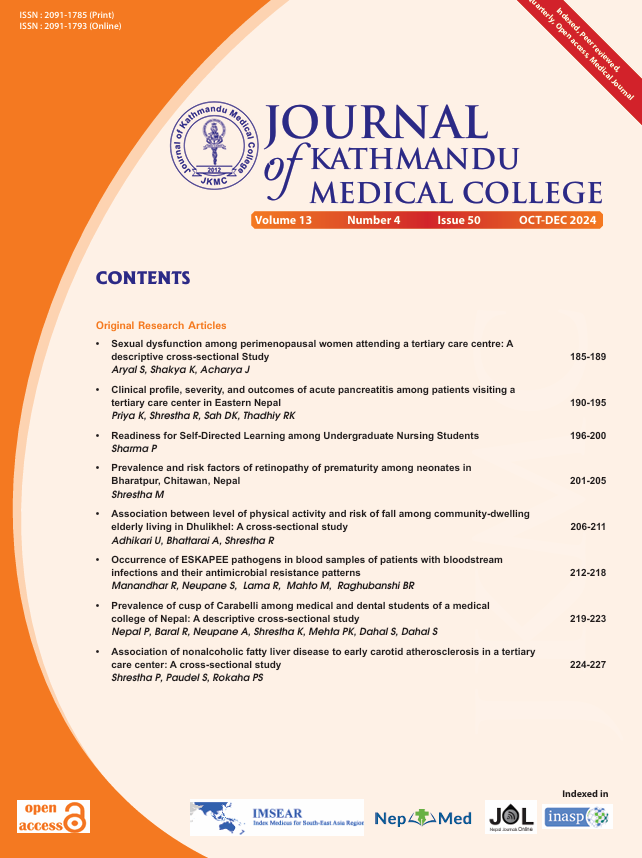
Introduction: Some of the most threatening drug-resistant microbes are the members of ESKAPEE group, an acronym for Enterococcus faecium, Staphylococcus aureus, Klebsiella pneumoniae, Acinetobacter baumannii, Pseudomonas aeruginosa, Enterobacter spp., and Escherichia coli which are posing a constant risk with increasing treatment challenges worldwide.
Objectives: To determine the occurrence of ESKAPEE pathogens in blood samples of patients attending and determine their antimicrobial resistance pattern.
Methodology: This hospital based cross-sectional study was conducted in the Department of Microbiology, KIST Medical College Teaching Hospital retrospectively. The records were obtained from culture and sensitivity test performed on all the blood samples received in the Microbiology Laboratory from July 2023- June 2024. The data was entered and analyzed in WHONET 2024 program.
Results: Out of 4180 blood samples received, pathogenic bacteria were isolated from 108 samples. ESKAPEE pathogens constituted 68.5% of total bacterial isolates. Five (6.75%) Enterococcus spp, 33 (44.59%) Staphylococcus aureus, 10 (13.5%) Klebsiella pneumoniae, 9 (12.16%) Acinetobacter spp., 3 (4.05%) Pseudomonas aeruginosa, 1 (1.35%) Enterobacter spp and 13 (17.56%) Escherichia coli were isolated. Sixty three percent Staphylococcus aureus were Methicillin resistant. Twenty percent Klebsiella pneumonaie and 23% Escherichia coli were Extended-Spectrum Beta-Lactamases producers. Sixty percent of Klebsiella pneumonaie and 22.22% Acinetobacter spp. showed carbapenem resistance.
Conclusion: Our study shows increased prevalence of ESKAPEE pathogens resistant to commonly used antibiotics. Judicious use of antimicrobials, active infection control practices, stringent antibiotic policy and regular surveillance is the need of the hour for preventing antimicrobial resistance.
References
Marturano JE, Lowery TJ. ESKAPE pathogens in bloodstream infections are associated with higher cost and mortality but can be predicted using diagnoses upon admission. InOpen forum infectious diseases 2019 Dec (Vol. 6, No. 12, p. ofz503). US: Oxford University Press. [PubMed │Full Text │ DOI]
Bereanu AS, Bereanu R, Mohor C, Vintilă BI, Codru IR, Olteanu C, Sava M. Prevalence of infections and antimicrobial resistance of ESKAPE group bacteria isolated from patients admitted to the intensive care unit of a county emergency hospital in Romania. Antibiotics. 2024 Apr 27;13(5):400. [PubMed │Full Text │ DOI]
Zaman SB, Hussain MA, Nye R, Mehta V, Mamun KT, Hossain N. A review on antibiotic resistance: alarm bells are ringing. Cureus. 2017 Jun 28;9(6). [PubMed│Full Text │ DOI]
Suwantarat N, Carroll KC. Epidemiology and molecular characterization of multidrug-resistant Gram-negative bacteria in Southeast Asia. Antimicrobial Resistance & Infection Control. 2016 Dec;5:1-8. [PubMed│ Full Text │ DOI]
Yardimci AC, Arman D. Prevalence and antimicrobial resistance of bloodstream infections caused by ESKAPEEc pathogens: a five-year analysis. Jundishapur J. Microbiol. 2022 Jan 1;31:15. [Full Text │ DOI]
Marturano JE, Lowery TJ. ESKAPE pathogens in bloodstream infections are associated with higher cost and mortality but can be predicted using diagnoses upon admission. InOpen forum infectious diseases 2019 Dec (Vol. 6, No. 12, p. ofz503). US: Oxford University Press. [PubMed │Full Text │ DOI]
Ruekit S, Srijan A, Serichantalergs O, Margulieux KR, Mc Gann P, Mills EG, Stribling WC, Pimsawat T, Kormanee R, Nakornchai S, Sakdinava C. Molecular characterization of multidrug-resistant ESKAPEE pathogens from clinical samples in Chonburi, Thailand (2017–2018). BMC infectious diseases. 2022 Aug 17;22(1):695. [PubMed │Full Text │ DOI]
Pandey S, Raza S, Bhatta CP. The aetiology of the bloodstream infections in the patients who presented to a tertiary care teaching hospital in kathmandu, Nepal. Journal of Clinical and Diagnostic Research: JCDR. 2013 Apr 1;7(4):638. [PubMed │Full Text │ DOI]
de Paula L, Lopes GF, da Silva Santos FR, Oliveira AL, de Pilla Varotti F, da Cruz Nizer WS, de Paiva MC, Figueiredo RC, Ferreira JM. Prevalence of ESKAPEE pathogens as agents of healthcare-related infection in Brazil. The Microbe. 2025 Apr 2:100326. [Full Text │ DOI]
Sah RK, Bhattarai A, Khadka P, Sharma S, Mishra SK, Rai JR, Raut S. Current Antibiotic Resistance Profile of ESKAPE Pathogens in a Nepalese Hospital: A Cross‐Sectional Study. Canadian Journal of Infectious Diseases and Medical Microbiology. 2025;2025(1):4426596. [PubMed │Full Text │ DOI]
Kritsotakis EI, Lagoutari D, Michailellis E, Georgakakis I, Gikas A. Burden of multidrug and extensively drug-resistant ESKAPEE pathogens in a secondary hospital care setting in Greece. Epidemiology & Infection. 2022 Jan;150: e170. [PubMed │Full Text │ DOI]
Ceballos Vela MC, Castillo Ceballos CE, Marín Vargas JA, Villegas-Dominguez JE, Carranza Promotor GJ, Perez Villanueva M, Sosa Gonzalez YR, Bravo Sarmiento E, Alba Aburto DE. Epidemiology of ESKAPEE Complex at Veracruz Children’s Hospital during 2023. European Journal of Public Health. 2024 Nov;34(Supplement_3):ckae144-1490. [ PubMed│ Full Text │ DOI]
Yang S, Xu H, Sun J, Sun S. Shifting trends and age distribution of ESKAPEEc resistance in bloodstream infection, Southwest China, 2012–2017. Antimicrobial Resistance & Infection Control. 2019 Dec;8:1-0. [ PubMed │ Full Text │ DOI]
Parajuli NP, Parajuli H, Pandit R, Shakya J, Khanal PR. Evaluating the trends of bloodstream infections among pediatric and adult patients at a teaching hospital of Kathmandu, Nepal: role of drug resistant pathogens. Canadian Journal of Infectious Diseases and Medical Microbiology. 2017;2017(1):8763135. [PubMed │Full Text │ DOI]
Tishyadhigama P, Dejsirilert S, Thongmali O, Sawanpanyalert P, Aswapokee N, Piboonbanakit D. Antimicrobial resistance among clinical isolates of Staphylococcus aureus in Thailand from 2000 to 2005. Journal of the Medical Association of Thailand. 2011 Jul 11;92(8):8. [ PubMed │Full Text ]
Mootsikapun P, Trakulsomboon S, Sawanpanyalert P, Aswapokee N, Suankratay C. An overview of antimicrobial susceptibility patterns of grampositive bacteria from National Antimicrobial Resistance Surveillance Thailand (NARST) program from 2000 to 2005. J Med Assoc Thai. 2009 Aug 1;92(Suppl 4):S87-90. [PubMed │Full Text]
Shilpakar A, Ansari M, Rai KR, Rai G, Rai SK. Prevalence of multidrug-resistant and extended-spectrum beta-lactamase producing Gram-negative isolates from clinical samples in a tertiary care hospital of Nepal. Tropical Medicine and Health. 2021 Dec;49:1- 9. [PubMed │Full Text │ DOI]