
Keywords
Newborn
Stool
Urine
How to Cite
Abstract
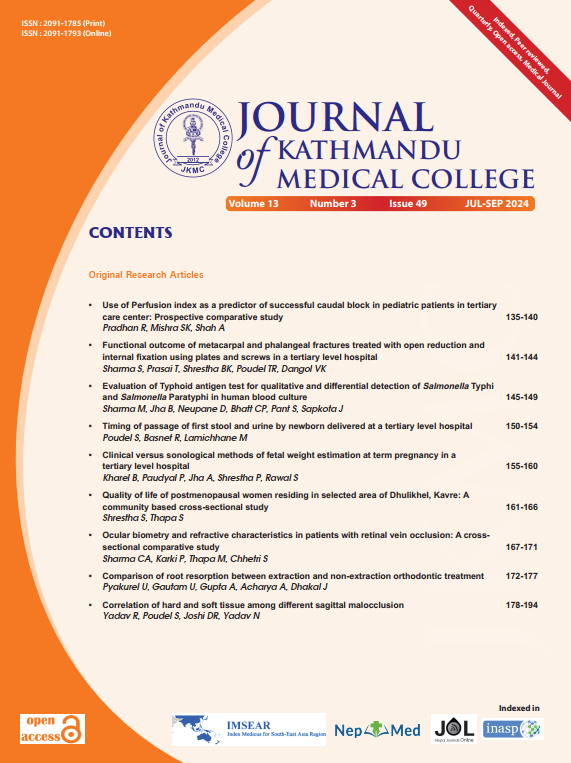
Introduction: Passage of first stool and urine is considered as one of the reassuring indicators to exclude some important congenital anomalies of gastrointestinal and genitourinary tract. Also, it is a sign that the newborn is healthy. Different studies from different geographical reasons have shown varying results in the timing of first passage of it. Hence this study aims to assess timing of passage of first stool and urine by newborn in our setting.
Objectives: To assess the timing of passage of first stool and urine by newborn.
Methodology: A descriptive observational study was carried out among 210 newborns born at Kathmandu Medical College Teaching Hospital, for the period of six months using convenient sampling technique. Data were analyzed by using frequency percentage and Mann-Whitney U test to see the associations.
Results: Study showed that 92.9% of newborns passed their first stool within eight hours of life and remaining 7.1% within 16 hours. Most of them i.e., 66.7% of newborns passed urine within 8 hours of life where as 6.7% of newborn passed their first urine beyond 24 hours. There was significant association between type of delivery and timing of passage of first stool (p = <0.05) and urine (p = <0.05). Timing of passage of first stool was significantly associated with type of oral feeding (p = <0.05).
Conclusion: Most of the newborn pass their first urine and stool within 24 hours of birth but few of them can go beyond 24 hours for urine without subsequent abnormality.
References
Kayiran S, Eroglu E, Kayiran P, Sazak S, Gurakan B. Meconium/Stool and Urinary Patterns of Healthy Turkish Newborns. Marmara Medical Journal. 2012 Oct 1;25(3):143-7.[Full Text | DOI]
Pierro A, De Coppi P, Eaton S. Neonatal Physiology and Metabolic Considerations. Pediatric Surgery. 2012 Jan 1; 2:89–107. [Full Text | DOI]
Kramer I, Sherry SN. The time of passage of the first stool and urine by the premature infant. J Pediatr. 1957 Oct;51(4):373-6. [PubMed | Full Text| DOI]
Omoigberale AI, Okolo AA. Time of passage of first stools and serum levels of calcium and magnesium in Nigerian neonates. Niger J Clin Pract. 2009 Mar;12(1):54–7. [PubMed | Full Text]
Ezomike UO. Evaluation of Impact of Perinatal Factors on Time to First Meconium Passage in Nigerian Neonates. Malawi Medical Journal. 2019;31(2):150. [PubMed | Full Text | DOI]
Gupta BK, Kaphle R, Gupta BK, Shresth S, Kumar NR, Chaudhary N. Meconium And Urinary Patterns of Healthy Term Newborns in a Tertiary Care Hospital Of Western Nepal- A Prospective Observational Study. Journal of Universal College of Medical Sciences. 2018 Nov 20; 6(1):8–10. [Full Text | DOI]
Hameed NN. The Time of First Passage of Meconium in Inborn Neonates In Baghdad Teaching HospitalMedical City. Medical Journal of Islamic World Academy of Sciences.2011 19:4, 165-172,). [Full Text]
Ameh N, Ameh EA. Timing of passage of first meconium and stooling pattern in normal Nigerian newborns. Ann Trop Paediatr. 2009 Jun 18;29(2):129– 33. [PubMed | Full Text | DOI]
Chowdhry BK, Kumar CM, Gupta P, MF G, Choudhary N, Kumar P, et al. Timing of passage of first urine and meconium after birth in newborns delivered at a tertiary-care health center in Eastern India. 2022. [Full Text | DOI]
Okoro P, Enyindah C. Time of passage of first stool in newborns in a tertiary health facility in Southern Nigeria. Nigerian Journal of Surgery. 2013;19(1):20- 22. [PubMed | Full Text | DOI]
Metaj M, Laroia N, Lawrence RA, Ryan RM. Comparison of breast- and formula-fed normal newborns in time to first stool and urine. Journal of Perinatology. 2003 Dec;23(8):624–8. [Pub Med | Full Text | DOI]