
Keywords
Medical Humanities
Assisted Reproduction
Kinship
Reproductive Ethics
How to Cite
Abstract
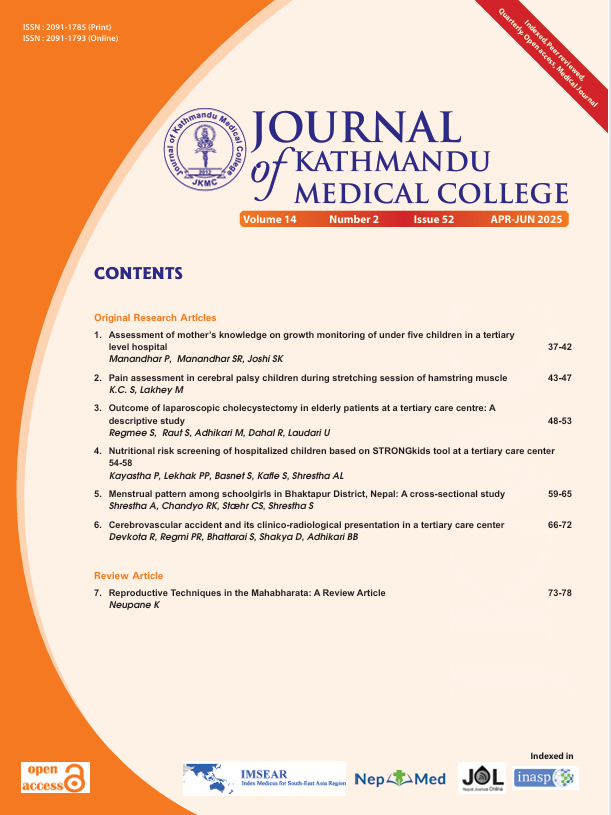
Introduction: This study highlights how the Mahabharata, a narrative epic, describes reproductive methods that
presage contemporary reproductive procedures and familial connections. These include extracorporal gestation, niyoga
(surrogate reproduction), divine conception, ayonija birth (non-womb birth, embryo splitting, proto-epigenetics, and
social constructions found within the Mahabharata.
This research seeks to explore how the Mahabharata, an epic, presents reproductive techniques, foreshadowing modern
procreative practices and kinship arrangements. It unveils extracorporeal gestation (development outside the body),
niyoga (proxy reproduction), divine conception (non-human genetic agency), ayonija birth (non-womb birth), embryo
division, proto-epigenetics and socially constructed practices used in the epic.
Objectives: This review aims to explore the reproductive concepts in theMahabharataand meaningfully relate to modern
reproductive technologies, especially with ethical complexity, kinship, and the separation of biological, gestational, and
social roles.
Methodology: This study will use a qualitative methodology to study a chosen set of reproductive stories from the
Mahabharata through a medical humanities perspective by drawing parallels between ancient and contemporary
reproduction practices.
Results: The Mahabharata presents multiple reproductive models. Niyoga and divine conception employ mediated
reproduction. These forms separate biological, social, and gestational parenthood. In Kunti’s case, selective reproduction
is evident. Ambika and Ambalika experience psychological influence in childbirth. In the case of the Kauravas,
extracorporeal development is observed.
Conclusion: These observations suggest that reproductive themes from the Mahabharat have a significant connection
with modern reproductive technology in terms of ethics, kinship ties, and dissociation between biological, gestational,
and social aspects.
References
Franklin S. Biological relatives: IVF, stem cells, and the future of kinship. Durham: Duke University Press; 2013.[Full Text]
Strathern M. Reproducing the future: Anthropology, kinship, and the new reproductive technologies. Manchester: Manchester University Press; 1992.[Full Text]
Haraway.DJModest_Witness@Second_Millennium. FemaleMan©_Meets_OncoMouse.Feminism and technoscience. New York: Routledge; 1997. [Full Text]
Thompson C. Making parents: The ontological choreography of reproductive technologies. Cambridge: MIT Press; 2005 .[Full Text]
Firestone S. The dialectic of sex: The case for feminist revolution. New York: William Morrow; 1970. [Full Text]
Ardakani ZB, Akhondi MM, Behjati Ardakani Z, et al. The impact of third-party reproduction on family and kinship. J Reprod Infertil. 2021;22(1):15–24. [Pub Med | Full Text | DOI]
Ginsburg F, Rapp R. Conceiving the new world order: The global politics of reproduction. Berkeley: University of California Press; 1995 .[Full Text]
Kass L. Life, liberty and the defense of dignity: The challenge for bioethics. San Francisco: Encounter Books; 2002. [Full Text]
Chattopadhyaya D. Science and society in ancient India. Calcutta: Research India Publications; 1977. [Full Text]
Nanda M. Prophets facing backward: Postmodern critiques of science and Hindu nationalism in India. New Brunswick: Rutgers University Press; 2003. [Full Text]
Ganguli KM, translator. The Mahabharata of KrishnaDwaipayana Vyasa. Calcutta: Bharata Press; 1883– 1896. [Full Text]
Rose N. The politics of life itself: Biomedicine, power, and subjectivity in the twenty-first century. Princeton: Princeton University Press; 2007. JSTOR .[Full Text| DOI]
Jasanoff S. Designs on nature: Science and democracy in Europe and the United States. Princeton: Princeton University Press; 2005. [Full Text]
Waldby C, Cooper M. The human embryo in global bioeconomy: Biotechnology, reproduction and value. Durham: Duke University Press; 2014. [Full Text]
Van Balen F, Inhorn MC. Interpreting infertility: A view from the social sciences. New York: Routledge; 2002. [Full Text]
Parry S. Ectogenesis: The ethics of artificial womb technology. London: Routledge; 2017. [Full Text]
Inhorn MC, Birenbaum-Carmeli D. Assisted reproductive technologies and culture change. Annu Rev Anthropol. 2008;37:177–196. [Full Text | DOI]
Teman E. Birthing a mother: The surrogate body and the pregnant self. Berkeley: University of California Press; 2010. [Full Text| DOI]
Lock M, Nguyen V-K. An Anthropology of Biomedicine. Malden: Wiley-Blackwell; 2010. [Full Text]
Kleinman A. The Illness Narratives: Suffering, Healing, and the Human Condition. New York: Basic Books; 1988. [Full Text]
Habermas J. The Future of Human Nature. Cambridge: Polity Press; 2003. [Full Text]
Golombok S. Modern Families: Parents and Children in New Family Forms. Cambridge: Cambridge University Press; 2015. [Full Text | DOI]
Foucault M. The History of Sexuality, Volume 1: An Introduction. New York: Pantheon Books; 1978. [Full Text]